
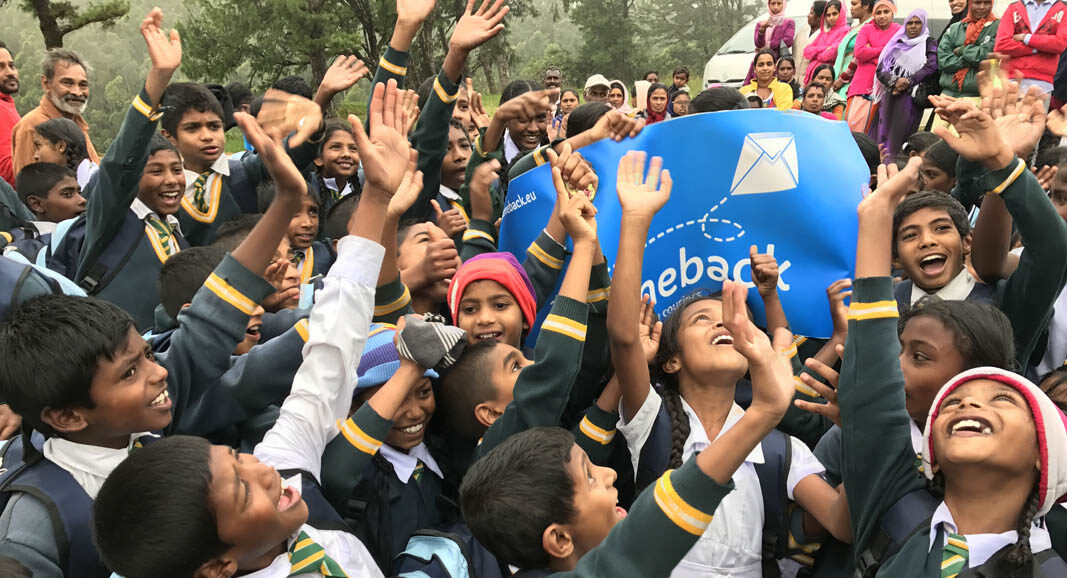
From travel and direct donations to the right to education: the Corrieri Solidali share a vision of sustainability that goes beyond the environment to address the very dignity of people.
Sustainability has become a smooth, polished, almost immaculate buzzword.
A word that's all too convenient.
It’s everywhere: in corporate financial statements, on green packaging, and in advertising campaigns built around the reassuring idea of a cleaner future.
It is a language that comforts, that brings order to the world, that transforms complexity into an easily recognizable symbol. A contemporary myth, as Roland Barthes might have written.
Yet there is a more fragile form of sustainability , one that is harder to describe.
A form of sustainability that is not measured in reduced emissions or recycled materials, but in a community’s ability to keep its people from leaving.
The gap we don't see
Because there is also a form of human waste.
Silent. Invisible. Everyday.
It’s the moment when a child stops going to school.
When a school is left without supplies.
When the right to education becomes a geographical privilege rather than a universal opportunity.
And this is where solidarity ceases to be merely charity and takes on a deeper meaning: it becomes a form of collective care.
Regeneration is a cultural act
Contemporary society produces waste at an astonishing rate: objects, information, relationships, people. Regeneration, then, becomes an act that goes against the grain. It is a cultural stance, even before it is an environmental one.
Educational poverty is a form of slow erosion. It makes no noise. It doesn’t make the headlines. Yet it erodes the future in a way that is even more profound than many visible crises.
In this sense, solidarity becomes the highest form of human sustainability: a concrete action capable of preventing entire lives from being deprived of the chance to envision their own future.
Choose not to be a bystander
When a company chooses to support a school in Tanzania or Sri Lanka, it isn’t simply “doing good.” It is standing up against the squandering of human potential. It is affirming that even a life that is distant, unknown, and seemingly marginal has a value worth preserving.
And perhaps this is precisely where the very concept of sustainability takes on a profoundly different meaning.
It’s not enough to recycle materials if we keep driving people apart. It’s not enough to reduce waste if the distance between people grows. It’s not enough to talk about the future if millions of children lack even the basic tools to imagine it.
The True Circular Economy
The true circular economy, then, might look like this:
A Solidarity Courier that travels the world not only to deliver tools, but to build relationships. A donor who chooses not to be a bystander. A company that decides to take a stand responsibly.
Different actions, yet all part of the same moral framework: nothing should ever be considered completely worthless. Not objects. Not people.
And so solidarity ceases to be an exceptional, isolated, distant act. It becomes a collective responsibility. A continuous form of care. A steadfast and deeply human effort to prevent anyone from being left on the margins of the world.
Whether you’re an individual or a business, there’s a way for you to get involved. No donation is too small. No gesture is too simple.